10 Time Management Tips That Actually Work (Backed by Research)

Skip the Generic Advice
Most time management tips read like they were written in 2005 and copy-pasted ever since. "Make a to-do list." "Set goals." "Avoid distractions." Thanks — groundbreaking stuff.
Here are 10 tips that actually hold up under scrutiny, each connected to real research in psychology, neuroscience, or behavioral science. No filler, no fluff, no advice you've already tried and abandoned.
1. Sort by Priority Before You Sort by Deadline
The research: A study published in the Journal of Consumer Research (2018) found that people systematically prioritize urgent tasks over important ones, even when the important tasks have objectively higher payoffs. Researchers called this the "mere urgency effect."
The tip: Before looking at deadlines, sort your task list by importance. Ask: "If none of these had deadlines, which ones would matter most to my goals?" Those go first.
The Eisenhower Matrix formalizes this by forcing you to evaluate tasks on two axes — urgency and importance — rather than just one. When you only sort by deadline, you optimize for urgency. When you sort by importance first, you optimize for results.
This is the single highest-leverage time management tip on this list. Everything else is a multiplier on top of it.
2. Protect Your First 90 Minutes
The research: Circadian rhythm studies consistently show that most people's peak cognitive performance occurs 2-4 hours after waking. Neuroscientist Andrew Huberman's work on alertness cycles confirms that the morning window (roughly 9-11 AM for a 7 AM riser) is when your prefrontal cortex — the brain region responsible for complex thinking and planning — is most active.
The tip: Treat your first 90 minutes of work as sacred. No email. No Slack. No meetings. Use this window for your most important, most cognitively demanding task.
This isn't about being a morning person (chronotype matters, and if you're a night owl, adjust the timing). It's about identifying your peak hours and defending them against low-value interruptions.
If your workplace expects immediate morning availability, negotiate. "I respond to messages after 10 AM" isn't unreasonable — and most bosses will accept it once they see your output improve.
3. Time Block in 90-Minute Cycles
The research: Sleep researcher Nathaniel Kleitman discovered that the human body operates on Basic Rest-Activity Cycles (BRAC) — approximately 90-minute cycles of high and low alertness that continue throughout the day, not just during sleep.
The tip: Work in focused 90-minute blocks, then take a genuine 15-20 minute break. Not a scrolling break — a real one. Walk, stretch, get outside, eat something.
This isn't the Pomodoro Technique's 25 minutes on / 5 minutes off (which research suggests is too short for deep work). The 90-minute cycle aligns with your body's natural rhythm and gives you enough continuous time to reach a flow state.
Structure your day as three to four 90-minute blocks with breaks between them. That's 4.5 to 6 hours of focused work — which, for most knowledge workers, is more deep work than they currently achieve.
4. Batch Communication Into Windows
The research: A 2015 study from the University of British Columbia found that participants who checked email only three times per day reported significantly lower stress than those who checked freely. A study from the University of California, Irvine, found that after an email interruption, it takes an average of 23 minutes to fully return to the original task.
The tip: Check email and messages at set times — morning, midday, and afternoon. Outside those windows, close your email client and turn off notifications.
Three windows per day means you're still responsive (nobody waits more than a few hours), but you've eliminated the constant interruption tax. The 23-minute recovery cost applies to every single interruption, which means a day with 10 email checks costs you nearly 4 hours of refocusing time.
If your role demands faster response times, adjust to hourly windows. The principle is the same: intentional batches beat reactive monitoring.
5. Apply the Two-Minute Rule (But Only for Q3 Tasks)
The research: David Allen's two-minute rule from Getting Things Done is widely cited: if a task takes less than two minutes, do it immediately rather than adding it to your list. The cognitive cost of tracking a tiny task exceeds the cost of just doing it.
The tip: Use the two-minute rule, but with a filter. Only apply it to tasks that are urgent but not important (Quadrant 3). If a task is important, it deserves focused time regardless of how quick it seems — because "two-minute" tasks on important projects often reveal deeper work.
The danger of the unfiltered two-minute rule is that you spend your morning doing twenty two-minute tasks and accomplish nothing meaningful. The filtered version keeps small tasks from clogging your system while protecting your focus time.
6. Plan Tomorrow Before You Leave Today
The research: The Zeigarnik Effect shows that uncompleted tasks occupy more mental bandwidth than completed ones. Your brain keeps "open loops" running in the background, which is why unfinished work follows you home and disrupts your evening.
The tip: Spend the last 5-10 minutes of your workday writing tomorrow's priority list. This closes the loops — your brain releases the tasks because they're captured in a trusted system with a plan attached.
This habit does double duty: it prevents evening anxiety about tomorrow and gives you a running start in the morning. Instead of arriving at your desk and spending 30 minutes deciding what to do, you open your list and start.
7. Say No by Default, Yes by Exception
The research: Herbert Simon's concept of satisficing versus maximizing shows that people who accept "good enough" outcomes (satisficers) are more productive and happier than those who try to optimize every decision (maximizers). Applied to commitments: accepting fewer obligations leads to better outcomes on the ones you keep.
The tip: Make "no" your default response to new requests. Not rudely — but treat every new commitment as a trade-off: "If I say yes to this, what am I saying no to?"
Practical scripts:
- "I'd love to help, but I'm at capacity this week. Can we revisit next week?"
- "That sounds interesting. Let me check my priorities and get back to you."
- "I can't take this on, but [person] might be able to help."
The most productive people don't have superior time management. They have fewer commitments — which means each commitment gets more attention, energy, and quality.
8. Use Implementation Intentions
The research: Psychologist Peter Gollwitzer's research on implementation intentions shows that people who specify when, where, and how they'll complete a task are 2-3x more likely to follow through than those who simply intend to do it.
The tip: Transform vague goals into specific plans using "if-then" or "when-then" statements:
- Instead of "I'll work on the report": "When I sit down at my desk at 9 AM, I'll open the report document and write for 90 minutes."
- Instead of "I'll exercise this week": "When my alarm goes off at 6:30 AM on Monday, Wednesday, and Friday, I'll put on my running shoes and go for a 30-minute run."
- Instead of "I'll read more": "When I finish dinner, I'll read for 20 minutes before opening my laptop."
The specificity eliminates the decision point. When the trigger occurs (9 AM, alarm, finishing dinner), the action is pre-decided. No willpower needed to initiate — just follow the plan.
9. Conduct a Weekly Review
The research: Metacognitive research consistently shows that self-monitoring — reflecting on your own behavior and performance — is one of the strongest predictors of goal achievement. People who regularly assess their progress adjust their strategies more effectively.
The tip: Block 15-20 minutes weekly (Friday afternoon or Sunday evening) for a structured review:
- What got done this week? Acknowledge completions — this fuels motivation.
- What didn't get done? Why? Be honest. Was it deprioritized intentionally or did it slip?
- What are next week's top 3 priorities? Not tasks — priorities. The most important outcomes.
- What should I stop doing? Identify one activity to eliminate or reduce.
The weekly review is the most underrated productivity habit. Without it, you're driving without looking at the road. Weeks turn into months of reactive work before you realize your priorities have drifted.
10. Optimize Your Environment, Not Your Willpower
The research: Behavioral economist Brian Wansink's studies on choice architecture demonstrate that people's behavior is more influenced by their environment than their intentions. The famous study: people ate 45% more candy when a bowl was placed on their desk versus six feet away.
The tip: Redesign your physical and digital environment to make productive behavior the default:
Physical:
- Keep your phone in another room during focus blocks
- Set up your workspace the night before (open the document you'll work on, close everything else)
- Use noise-canceling headphones as a "do not disturb" signal
Digital:
- Remove social media apps from your phone's home screen
- Use website blockers during focus time
- Set your task manager as your browser's default new tab page
- Turn off all non-essential notifications permanently (not just during focus time)
Social:
- Tell colleagues your focus hours ("I'm heads-down 9-11, available after")
- Work in environments where others are also working (library effect)
- Find an accountability partner for weekly check-ins
The reason tips for managing your time often fail isn't that the tips are wrong — it's that they rely on willpower, and willpower is a depletable resource. Environmental design works because it doesn't require willpower. The right choice becomes the easy choice.
Putting It All Together
You don't need all ten of these suggestions for time management working simultaneously. Pick the two or three that address your specific bottleneck:
- If you work on the wrong things: Start with Tip 1 (priority sorting) and Tip 9 (weekly review).
- If you can't focus: Start with Tip 2 (protect first 90 minutes) and Tip 4 (batch communication).
- If you're overcommitted: Start with Tip 7 (say no by default) and Tip 10 (environment design).
- If you procrastinate: Start with Tip 6 (plan tomorrow today) and Tip 8 (implementation intentions).
Give your chosen tips two weeks before evaluating. Behavior change takes time, and the first week often feels harder as you break old patterns.
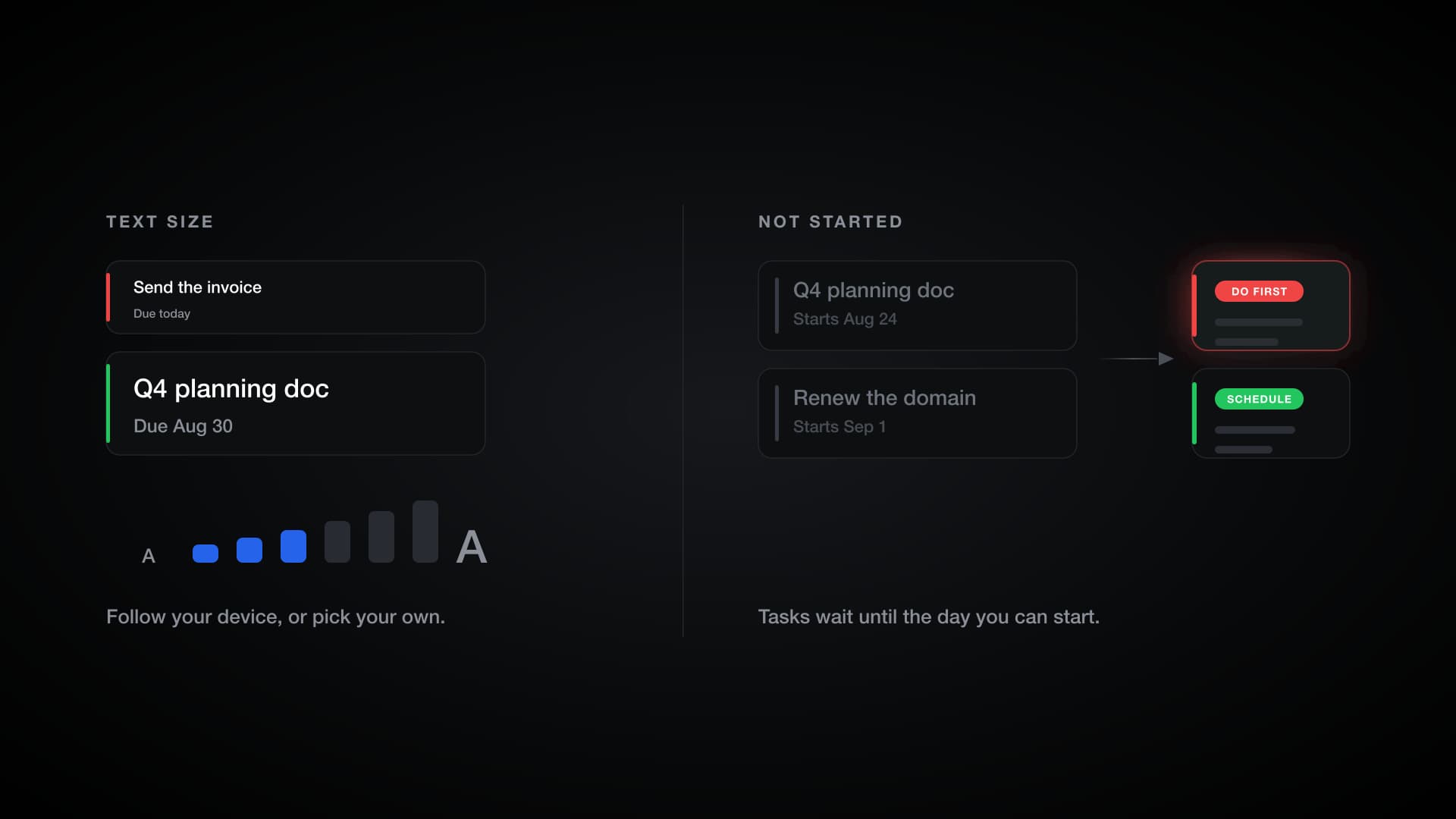
For the priority-sorting approach in Tip 1, apps like Focus Matrix make the process visual — you sort tasks into an Eisenhower Matrix grid and immediately see where your attention should go. But a notebook and pen work too. The tool matters less than the habit.
The best time management system isn't the most sophisticated one. It's the one that gets you working on the right things, consistently, with enough energy left to enjoy the rest of your life.