The Eisenhower Matrix for Freelancers: Prioritize Client Work Without Losing Your Mind

Freelancing sounds like freedom until you're juggling three client projects, chasing an overdue invoice, answering a prospect's email, updating your portfolio, doing your own accounting, and wondering when you last ate a meal that didn't come from a microwave.
The fundamental challenge of freelancing isn't finding work or doing good work. It's managing the chaos that comes from being the CEO, the employee, the accountant, the marketer, and the janitor — all at once. Every hat you wear generates tasks, and without a system, those tasks pile up until you're reactive, stressed, and spending your best hours on whatever screamed loudest that morning.
The Eisenhower Matrix is particularly well-suited for freelancers because it forces a distinction most freelancers ignore: the difference between client urgency and business importance.
Why Standard Productivity Advice Fails Freelancers
Most productivity frameworks assume you have a manager setting priorities, a team handling delegation, and a single role with defined boundaries. Freelancers have none of that.
You can't delegate Quadrant 3. In a corporate setting, urgent-but-not-important tasks get handed to someone else. When you're a team of one, there is no someone else. You do the admin, the invoicing, the client communication, and the actual work. This means you need a different strategy for Quadrant 3 — one based on batching, automating, and reducing, rather than delegating.
Every client thinks their project is Quadrant 1. Clients don't see your other commitments. To them, their deadline is the deadline. Managing multiple clients means managing multiple people who all believe their work is your top priority.
Business-building work has no deadline. Updating your portfolio, writing case studies, networking, learning new skills — this is classic Quadrant 2 work. It's essential for long-term income stability, but no client is going to email you demanding that you work on your marketing strategy. So it gets pushed. Indefinitely.
The Freelancer's Eisenhower Matrix
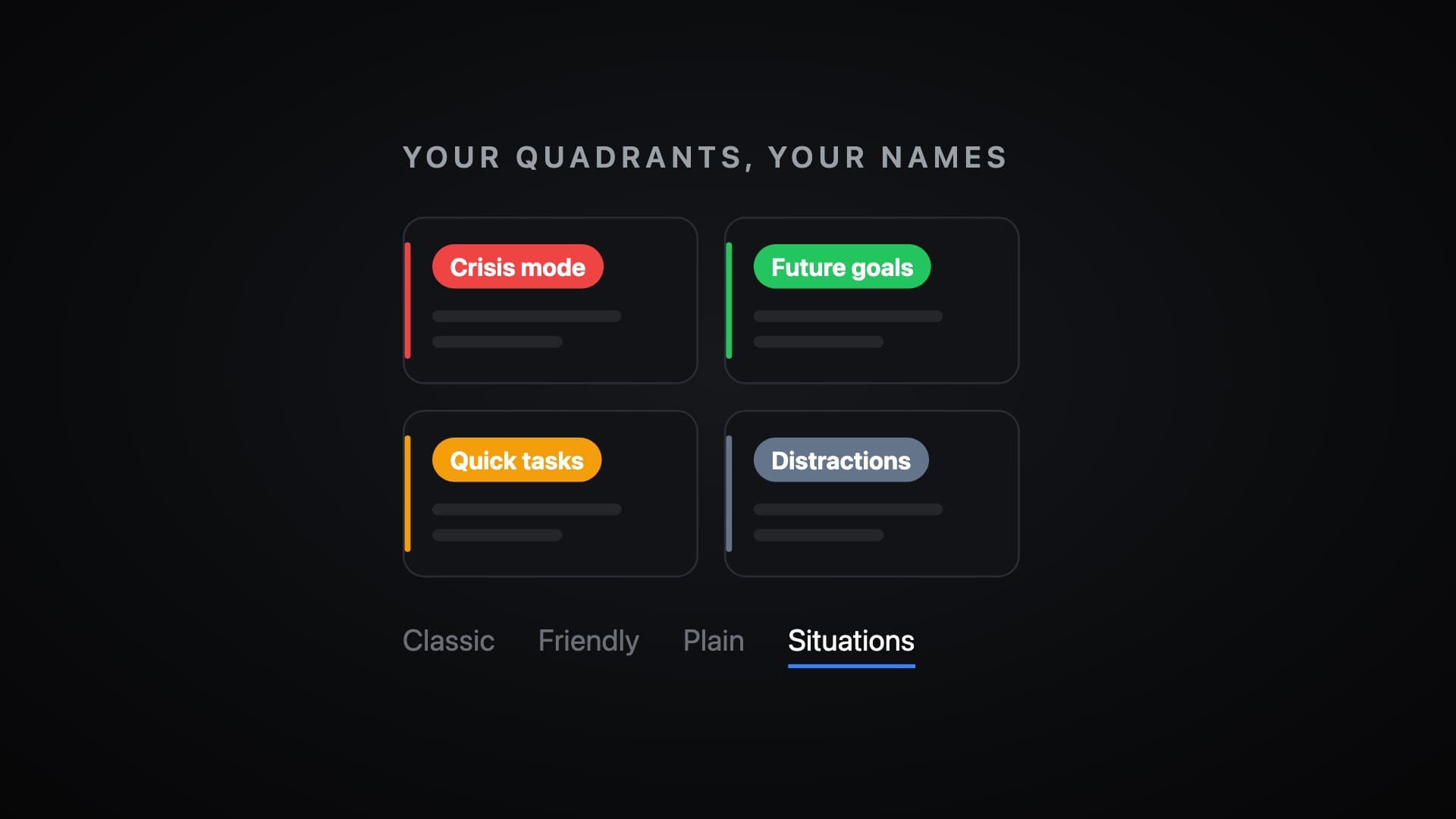
The standard four quadrants apply, but what goes in each one looks different when you're self-employed.
Quadrant 1: Urgent and Important — Active Client Deadlines
This is work that's due soon, for a client who's paying you, on a project that matters for your reputation or income. Examples:
- Client deliverable due in 48 hours
- A bug or error in work you shipped that needs an immediate fix
- A contract negotiation with a deadline
- Tax filing before the deadline
Quadrant 1 is where you earn today's income. You can't ignore it. But the goal is to minimize the time you spend here by planning better — most Quadrant 1 crises started as Quadrant 2 items that were neglected too long.
Quadrant 2: Important but Not Urgent — Business Growth
This is the quadrant that determines whether you're still freelancing successfully in two years. Examples:
- Updating your portfolio with recent work
- Writing proposals for higher-value clients
- Learning a new skill that expands your services
- Building relationships with potential referral partners
- Creating templates and systems that speed up future work
- Setting up proper contracts, invoicing, and project management
- Financial planning and saving for taxes
None of these have a client breathing down your neck. All of them compound over time. A freelancer who spends 20% of their week on Quadrant 2 will out-earn a freelancer who spends 100% of their time on client work, because the Quadrant 2 freelancer builds a better business.
Quadrant 3: Urgent but Not Important — Administrative Noise
These are tasks that feel pressing but don't directly produce value. Examples:
- Responding to non-urgent client emails within minutes
- Formatting invoices manually instead of using templates
- Attending a "quick call" that could have been an email
- Social media posting without a strategy
- Checking analytics obsessively
Since you can't delegate these to staff, your strategy is threefold:
- Automate — Use templates for invoices, contracts, and common emails. Set up automatic billing where possible.
- Batch — Handle all administrative tasks in one block (e.g., Monday morning for 90 minutes) rather than scattering them throughout the week.
- Eliminate — Ask: "What would happen if I stopped doing this?" If the answer is "nothing meaningful," stop.
Quadrant 4: Neither Urgent nor Important — Time Sinks
These are the things you do when you're procrastinating or avoiding harder work:
- Endlessly tweaking your website's font choices
- Researching a tool you don't need
- Reading industry news for the fifth time today
- Reorganizing your file system (again)
- Browsing job boards "just to see what's out there"
Everyone does these sometimes. The problem is when they eat hours you can't afford to lose. Name them so you recognize them when they happen.
The Client Urgency Trap
The single biggest prioritization mistake freelancers make is treating every client request as Quadrant 1. A client emails at 10 AM asking for a minor revision. You drop everything and do it immediately. Another client Slacks you asking when you can hop on a call. You rearrange your afternoon.
By 5 PM, you've spent the entire day responding to other people's timelines and haven't touched your own priorities.
Here's the reframe: client responsiveness and client delivery are different things. You can acknowledge a request quickly ("Got it — I'll have this done by Thursday") without executing it immediately. Setting expectations is not the same as ignoring people.
Practical tactics:
- Set response windows. Check email/Slack at 9 AM, 1 PM, and 4 PM. Respond during those windows. Work without interruption in between.
- Clarify real deadlines. When a client says "ASAP," ask: "Is there a specific date you need this by?" Often the answer is "end of the week" — not "this instant."
- Batch revision rounds. Instead of making one small change every time a client asks, batch revisions into scheduled rounds. "I'll incorporate all your feedback and send an updated version on Wednesday."
Protecting Quadrant 2 Time as a Freelancer
The hardest part of freelancing isn't doing the work. It's doing the work that doesn't pay you today but pays you for years.
If you don't actively protect time for business development, skill building, and system improvement, it will never happen. Client work expands to fill all available time. Always.
The 80/20 split
Aim for roughly 80% client work and 20% business building. For a 40-hour week, that's 8 hours — roughly one full day — devoted to Quadrant 2 activities. Many successful freelancers dedicate Friday to this. No client calls, no deliverables. Just business growth.
If a full day feels impossible, start with two 2-hour blocks per week. Tuesday and Thursday mornings, before you open email. Even four hours of protected Quadrant 2 time per week will compound dramatically over a year.
What to do during Quadrant 2 time
Rotate through these activities based on what your business needs most:
- Week 1: Update portfolio with last month's best work
- Week 2: Send three outreach emails to potential clients or referral partners
- Week 3: Write a case study or blog post that demonstrates expertise
- Week 4: Improve one system (contracts, onboarding, invoicing, project tracking)
Each month, you've strengthened four pillars of your business without any single week feeling overwhelming.
Managing Feast-or-Famine Cycles
Freelancers know the cycle: three months of too much work, then a month of panic when projects end simultaneously. The Eisenhower Matrix reveals why this happens.
During feast periods, you spend 100% of time in Quadrant 1 (client delivery). Quadrant 2 (business development, pipeline building) gets zero attention. So when the current projects end, there's nothing in the pipeline because you stopped marketing yourself three months ago.
The fix is counterintuitive: do more business development when you're busiest, not when you're slow. Even 30 minutes a day of relationship maintenance and pipeline activity during busy periods prevents the famine that follows.
Send one email a day to a past client. Post one update about your work. Respond to one inquiry, even if you can't take the project right now ("I'm booked through October but would love to work together in November — can I follow up then?"). These tiny Quadrant 2 actions smooth out the income rollercoaster.
The Weekly Review for Freelancers
Every Sunday evening or Monday morning, spend 20 minutes answering these questions:
- What are my Quadrant 1 deliverables this week? List every client deadline. If there are more than you can handle, communicate proactively.
- What's my Quadrant 2 focus this week? Pick one business-building activity. Put it on the calendar.
- What Quadrant 3 tasks can I batch or automate? Look at last week's administrative time. Can any of it be eliminated?
- Am I doing any Quadrant 4 work I should stop? Be honest. Everyone has a few time sinks they're pretending are productive.
This weekly habit takes 20 minutes and prevents the slow drift toward all-reactive, no-strategic work that burns freelancers out.
Tools That Support the Framework
You can run this system in a notebook, a spreadsheet, or a dedicated app. The key is that your tool surfaces quadrants visually — so you can see at a glance whether you're spending time on what matters.
Focus Matrix is designed around exactly this workflow. You create tasks, assign them to quadrants, and see your week organized by urgency and importance rather than a flat list. The recurring tasks feature (available in the Pro tier) is particularly useful for freelancers who have repeating administrative work — you set it once and it shows up in the right quadrant every week.
Whatever tool you choose, the underlying principle is the same: the client who's emailing you right now isn't necessarily your highest priority. Your business depends on knowing the difference.